

It’s no longer September! So I can finally post about Banned Books! I’m a bit of a non-conformist and September has “Banned Books Week” in it- thus I could not post about banned books in September. Even more so, I could not call this post “banned books and such”. I know, It’s a bit odd and ridiculous to quibble over such little things, but I am who I am and what I am is a non-conformist, just as many of these books are! (see how I tied my non-conformity into being about books. I know, I’m a sneaky tricksy Hobbit).
J.R.R. Tolkien, in my not so humble opinion, is a genius. I love the Lord of the Rings (LoTR) Universe! I think this trilogy teaches us about the importance of friendship, doing things for the greater good, and enduring in spite of trials. Yet in 2011 this trilogy came in at #40 on the American Library Association’s (ALA) list of most banned books. Some want it banned because it features smoking characters. Some want it banned because it has witchcraft and it is called “irreligious”. In fact in 2001 a group in New Mexico publicly burned a large number of LoTR books due to the “witchcraft”.
So why ban a book? Well to even qualify for the ALA’s list of banned books, a book has to be challenged to be removed from a library. Why remove a book from a library? Most of the time a book is challenged or removed because someone believes the book contains information or descriptions of things that people, children, or YA readers should not read.

This lends me to the thinking of much of the early Catholic church. In my History of the English Language class in college we discussed at length how important it was to translate the Bible into English. Up to that point it was in Latin, the language of the educated people. Who could know what the Bible really said? Only those who knew Latin. One of the arguments for not translating it into English that we discussed was that, “If the people can read all the sins they aren’t supposed to do, they will start to be tempted to do those things. We can’t let them see what sins are available to do! This will just make them sin more!”
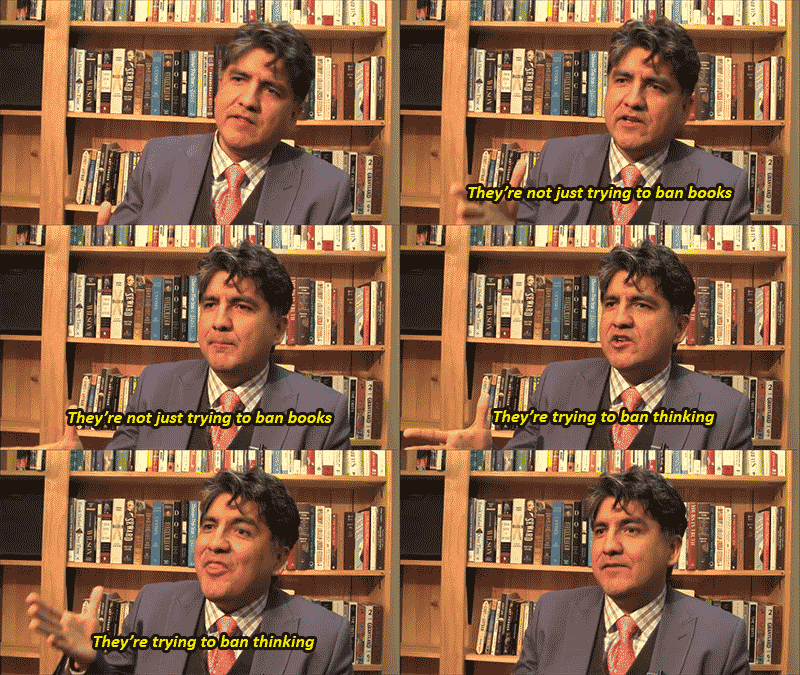
This tends to be the same type of nonsense that leads people to wanting to ban books. Control. Control of knowledge, control of people, control of thinking. “If the kids know about stabbing someone, they will want to go out and stab someone!” …. I’m not sure I can agree with that logic.
Now I firmly believe that a person has the right to read whatever they choose within the confines of their own life. That being said, if a parent does not want their child to read a book because of the content or a person is uncomfortable with the content of a specific book- close the book! Return the book to the library. Don’t hand the book to your child. It is your right to do so.
You have that right! You have the right not to read a banned book. But you may be surprised at some of the books that have appeared on the banned books list and why they were challenged to be banned.
- Where the Wild Things Are by Maurice Sendak- dark and frightening
- Harriet the Spy by Louise Fitzhugh- Harriet gossips and slanders without showing remorse for her actions
- In 1969: The Dictionary – for containing definitions to “inappropriate” and “slang” words
- Diary of a Young Girl by Anne Frank- containing sexually explicit passages and “being a real downer”
- The Lorax by Dr. Seuss- anti-deforesting
- Hansel and Gretel by the Grimm Brothers- gives witches a bad name
- The Giver by Lois Lowry- violence, sexually explicit, talks about euthanasia
- Twelfth Night by William Shakespeare- promotes alternative lifestyles
- James and the Giant Peach by Roald Dahl- the spider licking its lips could be taken as sexual
- Harry Potter by J.K. Rowling- sorcery
- Speak by Laurie Halse Anderson- sexually arousal (to which Anderson responded that rape is not sexually arousing, it is a crime)
- The Bible– religious viewpoint
- The Quran – religious viewpoint
I wonder how many of these books you have read. Did you realize that all these books had been challenged and/or banned?

We have Intellectual Freedom. The ALA defines intellectual freedom as, ” the right of every individual to both seek and receive information from all points of view without restriction. It provides for free access to all expressions of ideas through which any and all sides of a question, cause or movement may be explored. “
So let’s think about the motivation behind someone seeking to get a book banned. Laurie Halse Anderson has said that when a challenge to a book for children and YA readers happens it “most often comes from a place of love and concern. My first response is compassion.” And this is the woman who was told that her book Speak was “soft pornography”. (from personal reading and teaching of this book I can emphatically state that the RAPE in this book is not pornography and there are no instances in the book that would suggest otherwise).
Most people want to ban a book because they don’t agree with the content and they want to keep their, and other, children from reading the book. I can understand choosing that for yourself, but your job is not to police the world. Your job is not to decide other people’s morality. Understand that different people need different things.
When it comes to public and school libraries, understand that intellectual freedom in those places matter. Just because the point of view of the book is different than yours, doesn’t mean there isn’t someone else who needs that point of view represented.
So now I challenge you- go read a banned book! And share your favorite banned books in the comments!
Keep Sparkling,
B
Side Note- the author would like to note that the Catholic Church has done many wonderful things and her comparing banning books to one instance in the history of the Catholic Church is not meant as a derogatory commentary on the current Catholic Church.
 The Sparkling Librarian